Nothing kills the magic of a “home of the future” faster than a spinning loading icon. You’ve invested in the latest smart fridges, AI-powered security cameras, and intelligent lighting, yet they all seem to “go offline” at the worst possible moment. The culprit? That basic, dusty router provided by your ISP that was never designed to handle sixty concurrent device connections.
In 2026, the best routers for smart homes in the UK must do more than just provide internet; they must manage a complex ecosystem of traffic. With the rollout of Wi-Fi 7 and the increasing density of British housing, choosing a router that can cut through interference is essential. This guide reviews the top seven routers currently dominating the UK market, ensuring your smart home stays smart.
1. Best Overall: TP-Link Deco BE85 (Wi-Fi 7 Mesh System)
If you want the absolute pinnacle of home networking in 2026, the TP-Link Deco BE85 is the undisputed king. As a Wi-Fi 7 mesh system, it doesn’t just cover your house in signal; it creates a massive “multi-link” highway that allows your devices to send and receive data simultaneously across different bands.
Key Features
- Wi-Fi 7 Technology: Multi-Link Operation (MLO) for drastically reduced latency.
- 10 Gbps Ports: Ready for the fastest fibre-to-the-premises (FTTP) connections in the UK.
- HomeShield: Real-time IoT protection to keep your smart gadgets safe from hackers.
Pros & Cons
- Pros: Incredible speeds over long distances; incredibly easy app-based setup; future-proof for the next decade.
- Cons: Extremely expensive; larger than older Deco units.
- Estimated UK Price: £549 (Single) / £999 (2-Pack)
- Best for: Large British homes with 50+ smart devices and gigabit broadband.
2. Best for High-Density Smart Homes: ASUS RT-BE96U
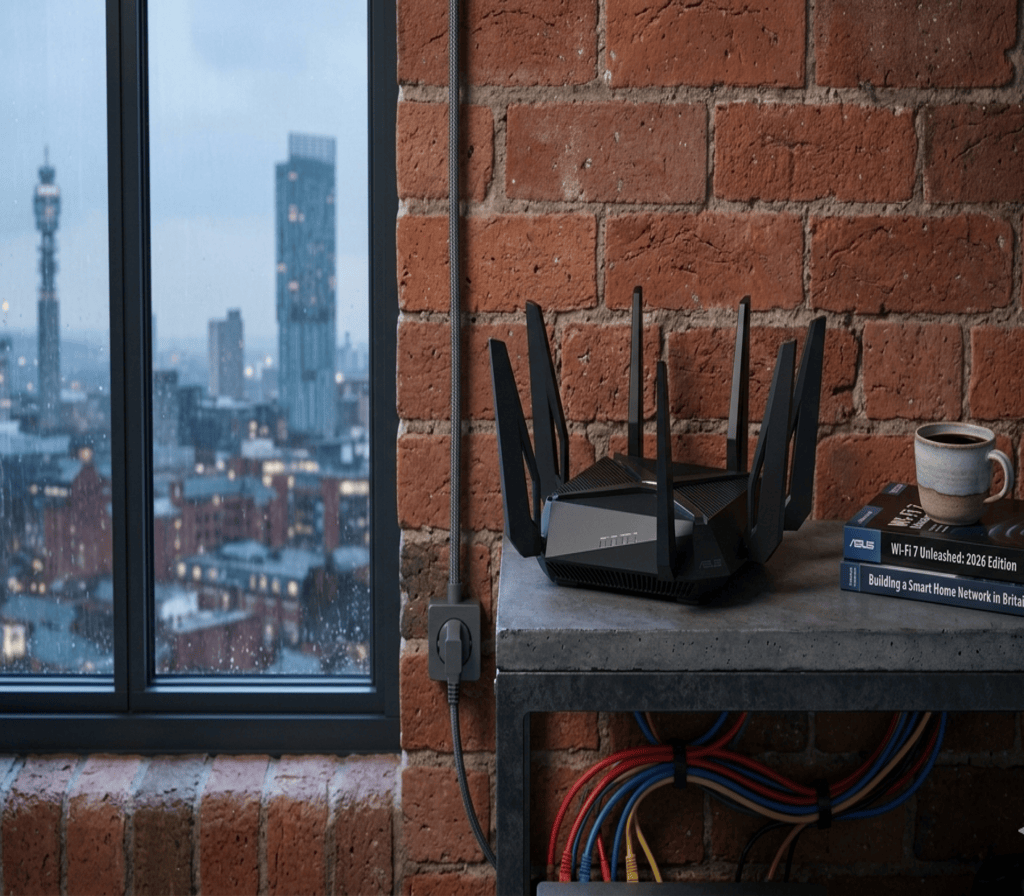
The ASUS RT-BE96U is a beast of a standalone router. It’s specifically designed for “noisy” environments—like terrace houses or flats in London—where dozens of neighbouring Wi-Fi signals interfere with your smart bulbs and plugs.
Key Features
- Tri-Band Performance: Dedicated bands to separate your smart home traffic from your Netflix streaming.
- AI Detection: Automatically prioritises traffic for video calls or security cameras.
- Subscription-Free Security: Trend Micro-powered AiProtection is included for life.
Pros & Cons
- Pros: Top-tier range for a single unit; advanced settings for tech enthusiasts; excellent security features.
- Cons: Aggressive “spider” design might not suit minimalist decor; very high power consumption.
- Estimated UK Price: £620 – £680
- Best for: Tech-heavy flats or medium-sized homes requiring maximum security.
3. Best Value Mesh: Amazon eero Max 7
The eero Max 7 is Amazon’s first foray into Wi-Fi 7, and it is built specifically for the Alexa ecosystem. If your house is full of Echo Dots, Ring cameras, and Blink sensors, this router will automatically recognise and optimise them.
Key Features
- TrueMesh Technology: Patented tech that dynamically finds the best path for data.
- Zigbee Built-in: Acts as a smart home hub, removing the need for extra bridges.
- Compact Design: Small enough to hide on a bookshelf.
Pros & Cons
- Pros: The simplest setup on the market; perfect integration with Amazon devices; very stable.
- Cons: Many advanced security features require an “eero Plus” monthly subscription; only two ethernet ports.
- Estimated UK Price: £449 (Single) / £799 (2-Pack)
- Best for: Households already deeply invested in the Amazon/Alexa ecosystem.
4. Best for Gamers & Smart Tech: Netgear Nighthawk RS700S
For many UK households, the router has to balance the needs of a professional gamer with the constant data pings of a smart fridge. The Nighthawk RS700S uses a new vertical internal antenna array to provide 360-degree coverage that penetrates thick British brick walls better than most.
Key Features
- New Aesthetic: A sleek, vertical tower that fits modern UK interiors.
- 19 Gbps Throughput: Faster than almost any consumer device currently available.
- Smart Connect: Intelligently picks the fastest band for every individual device.
Pros & Cons
- Pros: Stunning design; exceptional 4K and 8K streaming performance; solid parental controls.
- Cons: Netgear Armor security costs extra after the trial; vertical design can be tipped over easily.
- Estimated UK Price: £699 – £750
- Best for: Gaming households that also run intensive smart home security setups.
5. Best Mid-Range Option: Linksys Velop Pro 7
The Linksys Velop Pro 7 is the “sensible” choice for 2026. It offers the core benefits of Wi-Fi 7—specifically the ability to handle more devices without slowing down—at a price point that is significantly lower than the flagship TP-Link or Netgear models.
Key Features
- Cognitive Mesh: Uses AI to self-heal and optimise the network without user input.
- Fast Setup: Can be fully configured via Bluetooth in under 10 minutes.
- Eco-friendly Packaging: Fully recyclable, appealing to the environmentally conscious UK consumer.
Pros & Cons
- Pros: Great price-to-performance ratio; very stable firmware; minimalist “teardrop” design.
- Cons: Range is slightly less than the Deco BE85; app can be a bit slow.
- Estimated UK Price: £349 (Single) / £599 (2-Pack)
- Best for: Average-sized UK detached or semi-detached homes upgrading to Wi-Fi 7.
6. Best for Stability: Ubiquiti UniFi Cloud Gateway Ultra
If you are tired of “rebooting” your router every week, the Ubiquiti UniFi system is professional-grade gear scaled down for the home. It is incredibly stable and offers “dashboard” level data on every smart plug in your house.
Key Features
- Enterprise-Grade Hardware: Designed for 24/7 reliability.
- Deep Packet Inspection: See exactly which smart device is hogging your bandwidth.
- Wall-Mountable: Keeps the hallway clear of cables.
Pros & Cons
- Pros: Never needs a reboot; incredible data insights; very affordable for the quality.
- Cons: Requires separate “Access Points” for Wi-Fi; not for “plug-and-play” beginners.
- Estimated UK Price: £120 (Gateway only) + £150 per Access Point.
- Best for: “Prosumers” and enthusiasts who want total control over their network.
7. Best Budget Smart Router: TP-Link Archer BE230
You don’t always need to spend £500 to get a smart-home-ready network. The Archer BE230 is an entry-level Wi-Fi 7 router that provides the essential “Multi-Link Operation” needed to keep 2026 smart devices connected without the high price tag.
Key Features
- Entry-Level Wi-Fi 7: All the modern standards at a fraction of the cost.
- VPN Client Support: Secure your entire home’s traffic at the router level.
- EasyMesh Compatible: Add more TP-Link units later if you need more range.
Pros & Cons
- Pros: Incredible value; modern features; easy to use.
- Cons: Limited range (best for 2-3 bedroom homes); plastic build feels a bit cheap.
- Estimated UK Price: £149 – £179
- Best for: Small UK homes or apartments looking for a reliable, modern upgrade.
Comparison Table: Top UK Smart Home Routers 2026
| Model | Technology | Style | Best For | Price (Approx.) |
| TP-Link Deco BE85 | Wi-Fi 7 | Mesh | Large Homes | £549+ |
| ASUS RT-BE96U | Wi-Fi 7 | Standalone | Security & Flats | £620 |
| Amazon eero Max 7 | Wi-Fi 7 | Mesh | Alexa Users | £449 |
| Netgear RS700S | Wi-Fi 7 | Standalone | Gamers | £699 |
| Linksys Velop Pro 7 | Wi-Fi 7 | Mesh | Value Wi-Fi 7 | £349 |
| Ubiquiti UniFi | Enterprise | Wired/AP | Stability | £270+ |
| TP-Link BE230 | Wi-Fi 7 | Standalone | Budget Upgrade | £149 |
How to Choose the Best Router for Your Smart Home
When shopping for a router in the UK, “top speed” is actually the least important stat for a smart home. Instead, focus on these three factors:
1. Device Capacity
A standard router starts to “choke” at around 20 devices. A modern smart home (bulbs, plugs, cameras, fridge, assistants) can easily hit 50. Look for routers that specify “OFDMA” and “MU-MIMO” support, which allow the router to talk to multiple devices at once.
2. Mesh vs. Standalone
If you live in a thick-walled Victorian terrace, a single router in the hallway will never reach the back kitchen. A Mesh system (like Deco or eero) uses multiple “nodes” to blanket the house in a single, seamless network.
3. Security (The IoT Problem)
Smart devices are notoriously easy to hack. Choose a router with built-in IoT Protection (like ASUS AiProtection or TP-Link HomeShield). This acts as a digital “bouncer,” stopping suspicious traffic before it reaches your smart camera or baby monitor.
Final Recommendation
For most UK smart home owners in 2026, the TP-Link Deco BE85 is the best investment. Its ability to handle the high device density of a modern kitchen while providing “dead-zone” free coverage makes it worth the premium.
If you are on a budget but still want 2026-ready tech, the TP-Link Archer BE230 is a fantastic way to enter the Wi-Fi 7 era without breaking the bank.
FAQs (Snippet Optimisation)
Q: Do I need a Wi-Fi 7 router for my smart home?
A: You don’t “need” it yet for speed, but Wi-Fi 7’s ability to handle high device density and reduce interference is a massive benefit for smart homes with 40+ gadgets.
Q: Will my old smart plugs work with a Wi-Fi 7 router?
A: Yes. Wi-Fi 7 routers are “backwards compatible,” meaning your 2.4GHz smart bulbs and 5GHz laptops will connect perfectly.
Q: Can I replace my BT or Sky router with these?
A: Usually, yes. However, most UK ISPs require you to keep their “Hub” in “Modem Mode” or “Bridge Mode” and then connect your new smart router to it via an ethernet cable.
Learn more at TechToTable’s Smart Home Guides.