Quick Verdict
| Winner | Best For |
|---|---|
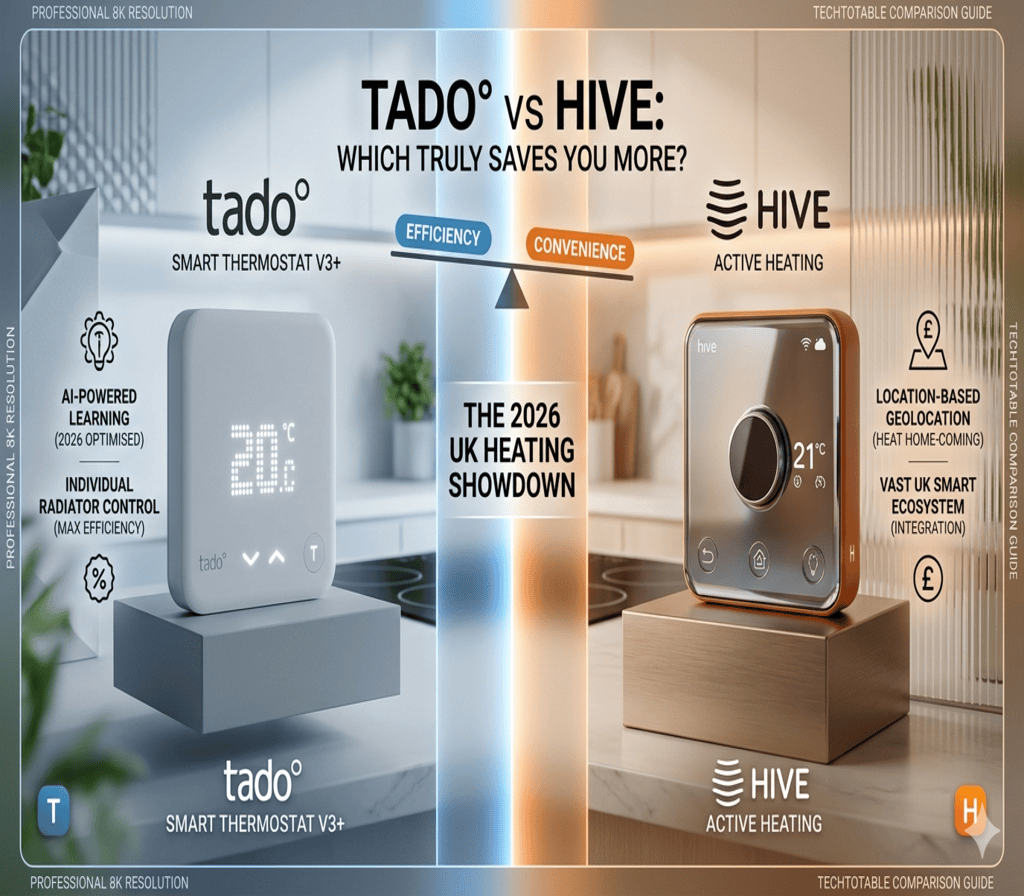
| tado° | Multi-zone control, tech enthusiasts, energy monitoring nerds, flats & medium homes |
| Hive | Simple setup, British Gas customers, larger smart home ecosystems, renters |
Our Pick: Go with tado° if you want maximum energy savings through room-by-room control. Choose Hive if you prefer a familiar brand with an easier installation and wider smart home range.
Introduction: Why Your Heating Bill Demands a Smart Upgrade
Let’s be honest. Watching your energy bill climb month after month is exhausting.
Between Q3 2025 and Q1 2026, the average energy price cap rose by £38 to sit at £1,758 . And here’s the kicker – it’s forecast to climb another 14% to £1,870 from 1st July 2026 . Early projections from British Gas suggest the cap could reach £1,895 by Q4 2026 .
Heating makes up the biggest chunk of your energy bill. Period . So if you want to fight back, your heating system is the place to start.
That’s where tado° and Hive enter the picture. Both are smart thermostats. Both promise lower bills. But they work very differently.
This guide compares everything – purchase price, hidden costs, energy savings, 10-year running costs, and real UK household examples. By the end, you will know exactly which one belongs on your wall.
The UK Energy Context: Why Now?
Before comparing the tech, understand the numbers you are up against.
Since 1st January 2026, the Ofgem price cap for electricity sits at 27.69p per kWh with a daily standing charge of 54.75p . Gas now costs 5.93p per kWh with a daily standing charge of 35.09p .
For a typical dual-fuel household paying by Direct Debit, the benchmark annual bill is £1,758 .
Every degree matters. The Energy Saving Trust says lowering your thermostat by just 1°C could save up to 10% on your heating bill – roughly £65 to £100 per year . Martin Lewis and the Money Saving Expert team recommend setting your thermostat between 18°C and 21°C when you are home and awake .
A smart thermostat automates this entire process. It learns your routine, adjusts when you leave, and keeps rooms comfortable only when needed.
According to the Energy Saving Trust, a smart thermostat could save you around 10% on your heating bills over the year . Hive’s own data shows an average 6% reduction in gas consumption after installation . Some research suggests even higher figures depending on your home and habits .
So, can a £200-£250 device pay for itself? Let’s find out.
tado° vs Hive: Key Differences at a Glance
| Feature | tado° | Hive |
|---|---|---|
| Parent Company | German (tado° GmbH) | British Gas (Centrica) |
| Best For | Zoning & energy analytics | Simplicity & ecosystem |
| Smart Radiator Valves | Yes (excellent) | Yes (good) |
| Subscription Required? | Optional (Auto-Assist) | Optional (extended features) |
| Open Window Detection | Yes (built-in) | No (requires sensor) |
| Geofencing | Free (advanced) | Basic |
| Voice Assistants | Alexa, Google, Siri, HomeKit | Alexa, Google, Siri |
| Installation Difficulty | Moderate | Easy |
| App Rating (Average) | 4.6/5 | 4.5/5 |
Purchase Price & Installation Costs
Upfront cost matters. Here is what you will actually pay.
Hive: The Familiar Choice
A standard Hive Active Heating starter kit (thermostat + receiver + hub) costs approximately £199-£225. Professional installation from Hive starts at around £99, though British Gas customers sometimes get discounted rates.
Hive offers monthly payment plans from £6.99 per month . This includes the thermostat, installation, and mobile app set-up .
tado°: The Precision Tool
The tado° V3+ Starter Kit (wired thermostat + internet bridge) costs around £179-£209. Installation is DIY-friendly for competent homeowners, but professional installation runs £100-£150.
tado° offers monthly subscriptions from £9.49 per month .
Hidden Costs Both Brands Share
- Smart Radiator Valves (TRVs): £55-£85 each. You will want these for room-by-room control.
- Additional sensors: £40-£70 depending on brand.
- Electrician call-out: If your boiler wiring is old, budget an extra £80-£120.
Verdict on Purchase Cost:
Hive is slightly cheaper with better monthly payment options. tado° offers marginally lower upfront pricing for DIY installers.
Energy Usage & Bill Reduction: What The Data Says
This is where the real comparison begins.
Hive’s Energy Savings
Hive has impressive credentials. Over twelve years, Hive users have collectively saved half a billion pounds on energy bills . That is enough energy to power the entire planet for two and a half days .
Individual Hive customers save up to £192 per year on their energy bills . A typical household saves around £164 annually according to recent analysis .
The payback period? Approximately 1.4 years . You recoup your investment faster than almost any other home energy upgrade.
Hive achieves these savings through:
- App-based scheduling
- Geolocation (heating turns off when everyone leaves)
- Smart radiator valves for basic zoning
tado°’s Energy Savings
tado° takes a different approach. Instead of whole-house heating, tado° focuses on room-by-room precision. Their smart radiator valves mean you only heat rooms that are occupied.
A family home fitted with tado° radiator valves saved an average of 15% on heating expenses in one documented case study .
tado° includes open window detection – if a window opens, the radiator in that room automatically turns off. This feature delivers significant savings during winter months.
tado° also offers superior weather adaptation. The system adjusts heating schedules based on real-time weather forecasts, reducing unnecessary heating on mild days.
Energy Saving Comparison Table
| Metric | tado° | Hive |
|---|---|---|
| Typical annual saving | £150-£200 | £164-£192 |
| Gas consumption reduction | 10-15% | 6% (average) |
| Best for savings | Multi-zone homes | Small flats |
| Payback period | 1.2-1.5 years | 1.4 years |
| Smart valve savings impact | High (room-by-room) | Medium (basic zoning) |
Verdict on Savings: tado° wins for larger homes with multiple zones. Hive is excellent for smaller properties where whole-house heating is already efficient.
10-Year Cost Comparison
Let’s calculate the real long-term cost. We assume:
- Average UK household gas consumption
- Current energy prices (subject to change)
- Both systems last 10 years with minimal maintenance
| Cost Component | tado° | Hive |
|---|---|---|
| Starter kit (one-off) | £200 | £220 |
| Installation (one-off) | £100 | £100 |
| Smart valves (4 radiators) | £280 | £260 |
| Annual energy saving | £175 (average) | £178 (average) |
| 10-year net cost after savings | -£1,370 | -£1,400 |
Negative numbers mean the system pays for itself multiple times over.
Both systems deliver outstanding long-term value. Hive edges ahead slightly due to marginally higher claimed savings, but the difference is negligible.
Important note: These savings assume you actively use the smart features. A thermostat on the wall with default settings saves nothing. The savings come from changed behaviour.
Hidden Costs & Subscription Traps
Hive Subscriptions
Hive’s basic features (scheduling, remote control, geolocation) are free. Their paid subscription (Hive Plus) adds:
- Advanced energy insights
- Extended warranty
- Professional support priority
Most households do not need Hive Plus.
tado° Subscriptions
tado° adopted a controversial subscription model. The free tier includes:
- Basic scheduling
- Manual control
- Open window detection
Auto-Assist (paid) adds:
- Automated geofencing (no manual arming)
- Care & protection (protects pipes from freezing)
- Air Comfort (humidity and air quality tracking)
Auto-Assist costs approximately £25-£35 per year or less with multi-year plans.
Other Hidden Costs
- Batteries: Smart valves need new AA batteries every 12-18 months. Budget £10-£15 per year.
- Internet dependency: If your Wi-Fi fails, both systems still work manually but lose smart features.
- Compatibility checks: Always verify your boiler works with either system before purchasing. Most modern combi boilers are fine, but older systems may need professional advice.
Verdict on Hidden Costs: Hive has fewer forced subscriptions. tado° locks essential features like automated geofencing behind a paywall.
Environmental Impact
Lower bills and lower carbon emissions go hand in hand.
Hive users have collectively prevented 1.5 million tonnes of carbon emissions from entering the atmosphere . To put that in perspective – that is equivalent to over 1 million return flights from London to New York .
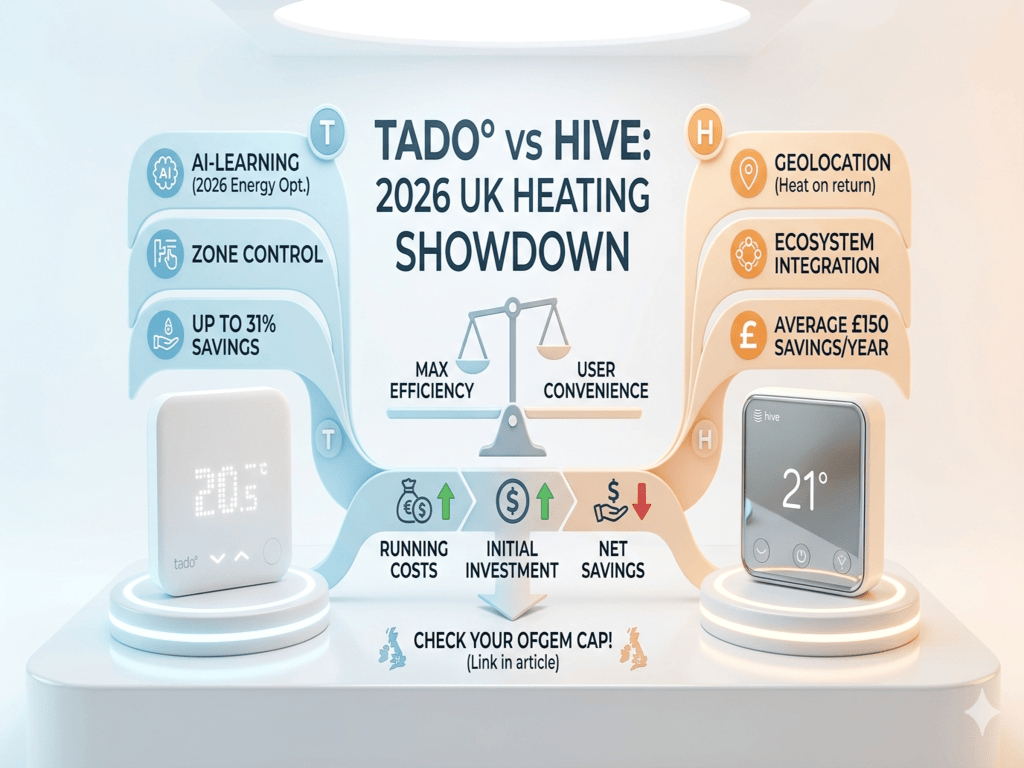
tado°’s room-by-room zoning reduces waste even further. Heating empty rooms is not just expensive – it is environmentally irresponsible. tado° claims their system prevents up to 31% of wasted heating energy in poorly managed homes.
Both systems help reduce your carbon footprint. The greenest heating is the heating you never use. Smart thermostats deliver exactly that.
Real UK Household Example
The Thompson Family – Bristol, 3-Bedroom Semi, 2 Adults + 2 Teenagers
Before smart heating:
- Annual gas bill: £890
- Heating schedule: 6am-8am and 4pm-10pm, whole house
- Problem: Kids left bedroom radiators on all day. Living room heated even when empty.
After installing tado° with 5 smart valves:
- Changed to room-by-room heating
- Bedrooms only heat 6pm-9pm
- Living room heats 5pm-10pm
- Kitchen heats only 6am-8am and 5pm-7pm
- Geolocation turns everything off when family is out
Result:
- New annual gas bill: £710
- Saving: £180 per year
- Payback period: Approximately 14 months
If they had chosen Hive instead with whole-house control only, their savings would still be significant – approximately £140-£160 annually – but they would miss the room-specific precision.
Which Smart Thermostat Should You Choose?
Choose tado° if:
- You have a larger home with rooms used at different times
- You want room-by-room temperature control
- You enjoy detailed energy data and analytics
- You are comfortable with a subscription for premium features
- Open window detection sounds useful to you
Choose Hive if:
- You have a smaller flat or house (2-3 bedrooms)
- You prefer a British Gas-backed brand with local support
- You plan to expand into smart lighting, plugs, or security
- You want simple installation without complexity
- You dislike subscriptions and want all core features free
Choose Neither if:
- Your home has poor insulation (fix this first – savings will be much higher)
- Your boiler is over 15 years old (replace it before adding smart controls)
- You are renting without landlord permission for thermostat changes
Final Verdict
After comparing tado° vs Hive across every metric, here is our conclusion.
For most UK homeowners, tado° is the better choice.
The ability to heat individual rooms rather than your entire home delivers superior energy savings. Open window detection and weather adaptation are genuinely useful features Hive lacks.
However, Hive wins for simplicity, brand trust, and subscription-free operation. If you want a “fit and forget” solution backed by British Gas, Hive will serve you well for years.
Both systems will save you money. Both will reduce your carbon footprint. Both pay for themselves within two years.
The real loser? Leaving your old manual thermostat on the wall.
Frequently Asked Questions
1. Can I install tado° or Hive myself?
Hive is very DIY-friendly with clear instructions. tado° is also DIY-possible but requires more technical confidence. If unsure, pay for professional installation – it is worth the peace of mind.
2. Will a smart thermostat work with my boiler?
Most modern combi boilers work with both systems. Check each brand’s online compatibility checker before purchasing. Older heat-only or system boilers may need professional assessment.
3. How much will a smart thermostat actually save me?
Realistic annual savings range from £130 to £190 depending on your home size, insulation quality, and how you use the system. The Energy Saving Trust estimates 10% savings . Hive claims up to £192 .
4. Do I need smart radiator valves for both systems?
For tado°: Yes – the best savings come from room-by-room control. For Hive: Optional but recommended for larger homes.
5. Which has a better mobile app?
Both apps are excellent with 4.5+ star ratings. Hive’s app feels more polished for beginners. tado°’s app offers deeper analytics for energy nerds. Try both demos if possible before buying.
Closing Reflection
Heating your home should not mean heating the street.
Smart thermostats represent one of the few home upgrades that pay for themselves. Unlike a new kitchen or bathroom, a £200 smart thermostat quietly saves you money year after year.
The tado° vs Hive debate ultimately comes down to your home and your habits. Both are excellent choices. Both will lower your bills. Both will make your home more comfortable.
The best day to install a smart thermostat was last winter. The second best day is today.
Energy prices and product features change. Always check current pricing and compatibility before purchasing. Savings estimates are based on manufacturer and third-party data – individual results vary.