
Last Updated: May 1, 2026
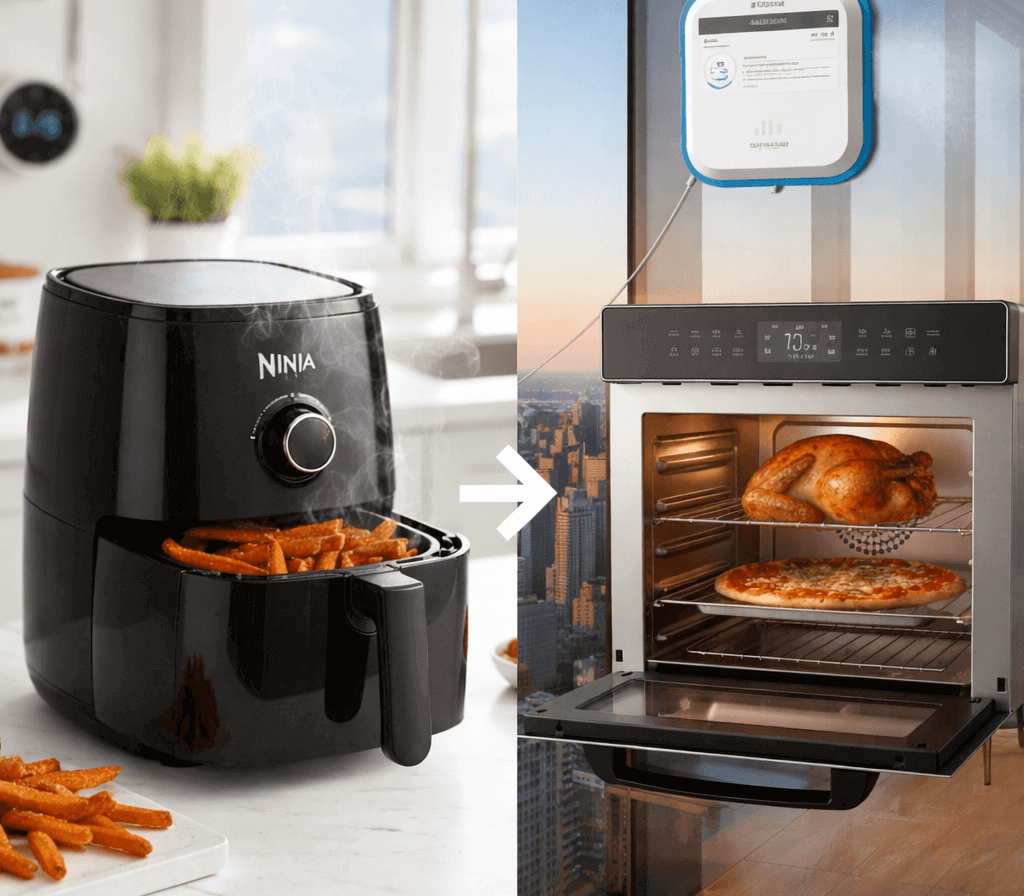
If you have limited kitchen counter space, choosing between an air fryer and a smart oven can feel like a real dilemma. Both appliances promise faster cooking, healthier meals, and modern convenience — but they are designed for very different cooking styles.
The 2026 Energy Verdict: Which is Cheaper to Run?
- Air Fryer: Best for 1–2 people. Cost per use: ~9p. Energy saved vs traditional oven: Up to 60%.
- Smart Oven: Best for families. Cost per use: ~24p. Advantage: Matter 2.0 integration for off-peak energy arbitrage.
- The Winner: For most UK households trying to lower their £1,758 annual bill, a smart air fryer is the most effective investment in 2026.
As we move into 2026, the line between these devices is blurring. Smart ovens now offer air-fry modes, while air fryers are becoming more advanced and connected. The result? Many buyers are unsure which appliance actually delivers better everyday value.
This in-depth comparison breaks down this comparison based on cooking performance, versatility, energy efficiency, counter space, and long-term practicality. By the end, you’ll know exactly which appliance deserves a permanent spot on your counter — and which one best fits your lifestyle.
✅ Quick Answer
Short answer:
If you want speed, simplicity, and minimal counter space, an air fryer is the better choice.
If you want versatility, smart automation, and family-size cooking, a smart oven offers more long-term value.
Understanding the Contenders
What Is an Air Fryer?
It is a compact counter top appliance that cooks food by circulating hot air at high speed. It mimics deep frying but uses little to no oil, making it popular among health-conscious households.
Best known for:
- Fast cooking
- Crispy textures
- Simple operation
- Minimal oil usage
What Is a Smart Oven?
A smart oven is an advanced version of a countertop convection or toaster oven. It often includes Wi-Fi connectivity, app control, presets, and multi-function cooking modes such as baking, roasting, broiling, dehydrating, and air frying.
Best known for:
- Versatility
- Larger capacity
- Precision cooking
- Smart automation
Performance & Cooking Results
Speed and Heat
- Air Fryer: Heats up almost instantly and cooks food faster due to its compact chamber.
- Smart Oven: Slightly longer preheat time but offers more consistent results for complex dishes.
Winner: Air Fryer (for speed)
Texture and Taste
- Air fryers excel at making foods crispy, especially fries, nuggets, and wings.
- Smart ovens produce better results for baked goods, casseroles, pizzas, and roasted meals.
Winner: Depends on what you cook most
Versatility: One-Trick vs Multi-Tool
Air Fryer Capabilities
- Frying (with little oil)
- Reheating leftovers
- Roasting vegetables
- Baking small items
Smart Oven Capabilities
- Baking
- Roasting
- Broiling
- Toasting
- Dehydrating
- Proofing dough
- Air frying (in many models)
Winner: Smart Oven — far more versatile
Counter Space & Kitchen Size
If you live in an apartment or have a compact kitchen, counter space matters.
- Air Fryer: Small footprint, easy to store
- Smart Oven: Larger and heavier, usually a permanent fixture
Winner: Air Fryer (for small kitchens)
Energy Efficiency & Electricity Costs
- In 2026, cooking a 20-minute meal in a standard air fryer costs approximately 9p. Because they don’t require long pre-heating times, they are up to 60% more efficient than traditional cooking methods.
- Smart Ovens: A 40-minute session in a smart oven (including pre-heat) costs roughly 24p. While they use more power, their ability to “batch cook” multiple dishes at once can be more efficient for large families.
Winner: Air Fryer (for daily bill reduction) Long-term efficiency: Smart Oven (if integrated with an AI Energy Arbitrage system to run during off-peak windows).
Verdict: Switch to an air fryer for 80% of your small meals to save an estimated £110 per year under the current price cap.
Long-Term Value and Appliance Lifespan
When comparing both, long-term value is often overlooked. Air fryers are affordable and efficient, but they typically have a shorter lifespan due to frequent high-heat usage and compact components. Smart ovens, while more expensive upfront, are designed for durability and multi-purpose use, often replacing several kitchen appliances at once. Over time, this can reduce overall kitchen clutter and replacement costs. If you plan to cook regularly and want a single appliance that adapts as your needs change, long-term value may favor a smart oven.
Ease of Use & Cleaning
Air Fryer
- Simple controls
- Non-stick baskets
- Dishwasher-safe parts
Smart Oven
- Touchscreens and apps
- More accessories to clean
- Requires learning presets
Winner: Air Fryer (simplicity)
Smart Features in 2026
“By 2026, the biggest trend is Matter 2.0. Smart ovens can now sync with your Energy Management System (HEMS) to automatically pre-heat when your tariff (like Octopus Agile) hits its lowest daily rate.”
Smart Oven Advantages
- App-based controls
- Voice assistant compatibility
- Recipe automation
- Firmware updates
Air Fryer Trends
- Smart air fryers are emerging
- App-controlled models available but limited
Winner: Smart Oven
Capacity & Family Size
- Air Fryer: Ideal for 1–3 people
- Smart Oven: Suitable for families and meal prep
If you cook for multiple people regularly, a smart oven offers better batch cooking.
Air Fryer vs Smart Oven: Comparison At a Glance
| Feature | Air Fryer | Smart Oven |
|---|---|---|
| Cooking Speed | Very fast | Moderate |
| Versatility | Limited | Very high |
| Counter Space | Compact | Large |
| Energy Use | Lower per use | Higher per use |
| Smart Features | Basic | Advanced |
| Best For | Quick meals, small homes | Family meals, baking |
| Price Range | Affordable | Premium |
Which One Is Right for You?
Maintenance, Durability, and Long-Term Ownership Costs
When choosing between an AF and a smart oven, maintenance and long-term ownership costs play a significant role—especially for users planning to rely on the appliance daily.
Cleaning and Maintenance Requirements
Air fryers are generally easier to clean. Most models come with removable, non-stick baskets that are dishwasher-safe. Because of their compact size, grease and food residue are confined to a small area, making routine cleaning quick and manageable.
Smart ovens, on the other hand, require more maintenance due to their size and multiple accessories. Crumb trays, racks, air-fry baskets, and drip pans all need regular cleaning. While many smart ovens include self-cleaning or steam-clean features, maintenance still takes more time compared to an air fryer.
Maintenance winner: AF
Durability and Appliance Lifespan
Air fryers are affordable but are often built with lighter components. Frequent exposure to high heat in a small chamber can reduce their lifespan, especially in budget models. Many users replace air fryers every 2–4 years depending on usage.
Smart ovens are designed for long-term use. Their construction is closer to traditional ovens, with stronger heating elements and higher-grade materials. With proper care, a smart oven can last 6–10 years, making it a longer-term investment.
Durability winner: Smart Oven
Repair and Replacement Costs
If an air fryer breaks, replacement is usually more cost-effective than repair. Spare parts are limited, and many brands do not support long-term servicing.
Smart ovens, while more expensive to repair, often come with extended warranties and manufacturer support. Replacement parts such as trays, racks, and accessories are easier to find, reducing long-term inconvenience.
Noise Levels and Kitchen Comfort
Air fryers rely on powerful internal fans, which can be noisy during operation. In small kitchens or apartments, this may become noticeable during frequent use.
Smart ovens tend to operate more quietly, especially during baking and roasting modes. While convection fans still produce some noise, it is generally less disruptive.
Sustainability and Environmental Impact
From a sustainability perspective, air fryers consume less electricity per cooking cycle due to shorter cooking times. However, frequent replacement increases electronic waste.
Smart ovens consume more power per session but reduce appliance redundancy by replacing multiple kitchen tools. Over time, this can lower overall resource usage.
Sustainability edge: Depends on usage habits
Overall Ownership Experience
If you prefer low maintenance, low cost, and quick replacement cycles, an air fryer fits well. If you value durability, versatility, and fewer appliance upgrades over time, a smart oven provides a more stable ownership experience.
Choose an Air Fryer if:
- You live alone or with one partner
- You want quick, healthy meals
- Counter space is limited
- You prefer simplicity
Choose a Smart Oven if:
- You cook diverse meals
- You bake frequently
- You want smart automation
- You have enough counter space
Learn more at TechToTable’s Smart Kitchen Guides
2026 Buying Tips
Before purchasing, consider:
- Appliance dimensions
- Wattage and energy ratings
- Smart ecosystem compatibility
- Replacement accessories availability
- Warranty and support
Frequently Asked Questions (FAQs)
1. Which is better: an air fryer or a smart oven?
It depends on your household size. One (AF) is better for singles or couples looking for the fastest, crispiest results for snacks and small meals. A smart oven is better for families or home cooks who need versatility (baking, roasting, dehydrating) and the capacity to cook multiple dishes at once.
2. What are the main disadvantages of an AF?
The primary drawbacks of an air fryer are its limited capacity (often requiring batch cooking for families) and the fact that it can dry out certain foods if overcooked. Additionally, you cannot cook “wet” batters (like tempura) in a standard air fryer basket.
3. Is 200°C in an air fryer the same as 200°C in an oven?
No. Because air fryers have a smaller chamber and much more powerful fans, 200°C in an AF is roughly equivalent to 220°C in a traditional oven. In 2026, many smart ovens now include an “Air Fry Conversion” feature to automatically adjust these temperatures for you.
4. Which appliance is healthier for daily cooking?
Both are significantly healthier than deep-frying. However, air fryers are generally considered the healthiest because they require 80–90% less oil to achieve a “fried” texture. Smart ovens are excellent for healthy roasting and steaming but may require slightly more oil to reach the same level of crispiness.
5. Is an AF cheaper to run than a smart oven?
Yes. Based on May 2026 UK energy rates, an average air fryer costs roughly £0.09 per meal, whereas a smart oven can cost £0.25+ due to larger heating elements and longer preheating times.
6. Can a smart oven completely replace an air fryer?
Yes, if it is a Smart AF Oven (like the Breville Joule or Ninja Foodi series). These models combine the rapid fan speed of an air fryer with the large capacity of an oven, essentially giving you two appliances in one footprint.
Final Verdict
There is no universal winner in the air fryer vs smart oven debate.
Choose an air fryer if speed, simplicity, and small-space cooking matter most.
Choose a smart oven if you value versatility, automation, and cooking for multiple people.
The best appliance is the one that matches how you actually cook — not just what looks impressive on your counter. Explore more smart kitchen comparisons at TechToTable to choose appliances that truly fit your cooking style.