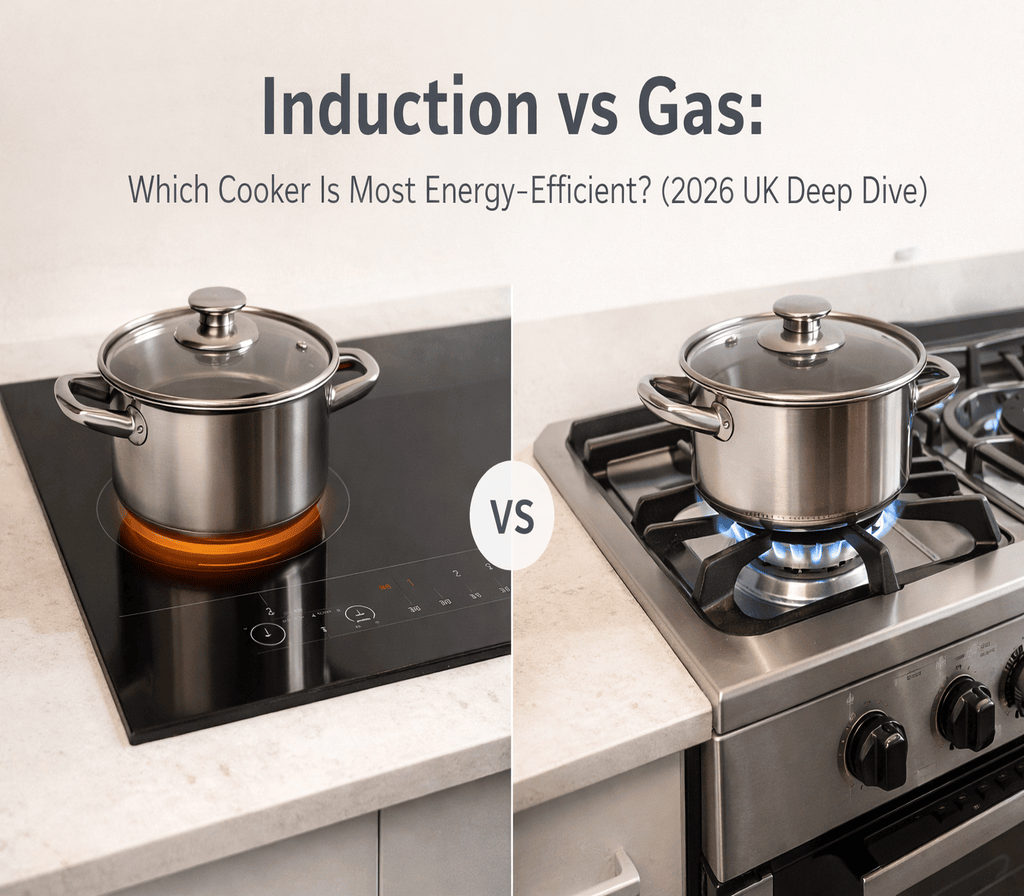
As we move through 2026, the British kitchen has become the frontline of household energy management. With the Ofgem Energy Price Cap (January–March 2026) setting electricity at 27.69p per kWh and gas at 5.93p per kWh, homeowners are faced with a stark choice. On the surface, gas appears nearly five times cheaper. However, when we look at Thermal Transfer Efficiency, the “cheap” blue flame starts to look like an expensive waste of energy.
In this 1,800-word authority guide, we strip away the marketing jargon to look at the raw science of cooking. We will explore why 60% of your gas bill is heating your ceiling, how magnetic friction revolutionises heat delivery, and why the UK’s “Future Homes Standard” is making the gas hob an endangered species.
1. The Science of Heat: Thermal Transfer Efficiency
In any energy system, efficiency is defined by how much “input” energy actually reaches the “target.” In cooking, the target is your food.
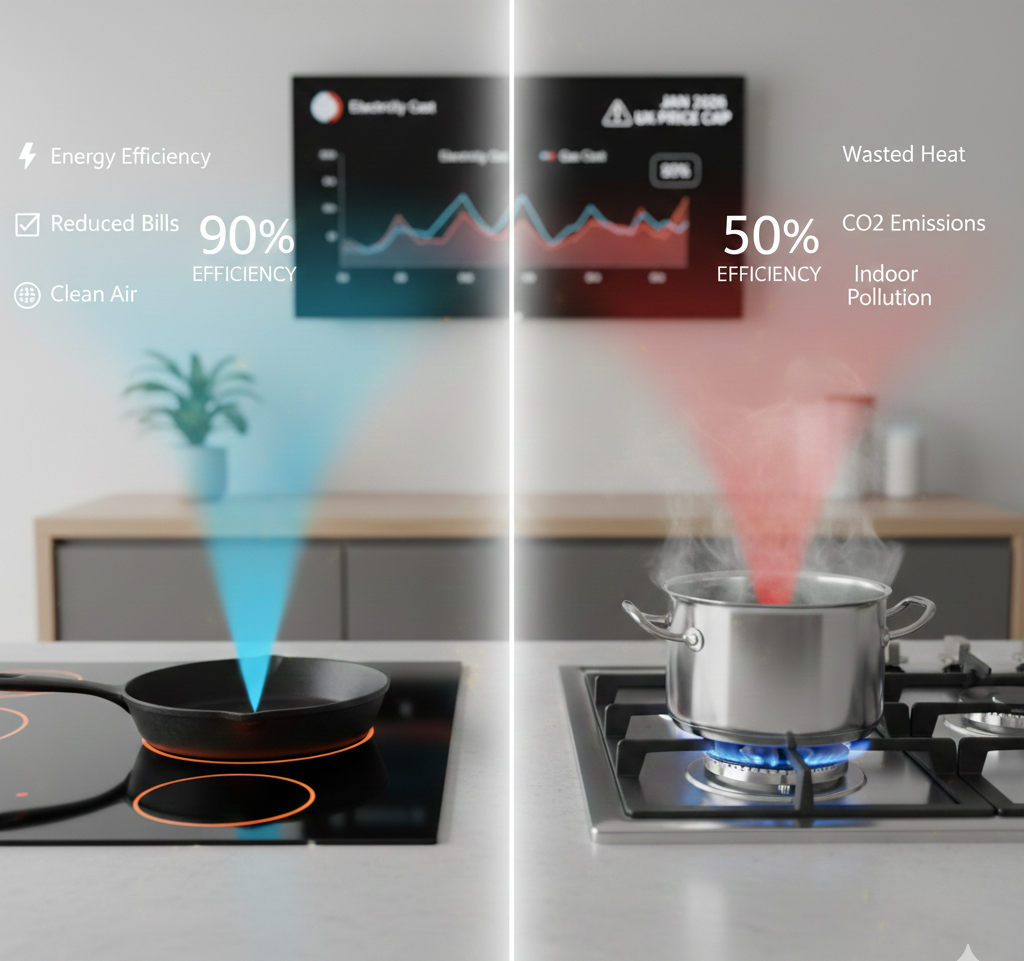
The Gas Reality: A 60% Waste Margin
Gas hobs rely on combustion. When you ignite a burner, you create a chemical reaction that releases thermal energy in the form of a flame. However, physics dictates that heat rises and spreads.
- Convection Loss: A significant portion of a gas flame’s heat escapes around the sides of the pan. This heat enters the air, warming your kitchen and often triggering your fridge-freezer to work harder to maintain its internal temperature.
- Thermal Efficiency: Laboratory tests in 2026 confirm that gas hobs operate at only 35% to 40% efficiency.
- The Math: For every £1.00 you spend on gas for cooking, 60p is wasted heating your kitchen air rather than your pasta water.
The Induction Edge: 90% Precision
Induction cooking does not “create” heat on a burner and move it to a pan. Instead, it uses electromagnetism to turn the pan itself into the heat source.
- Direct Transfer: Because there is no open flame and no red-hot heating element, there is almost no ambient heat loss.
- Thermal Efficiency: Induction hobs consistently hit 85% to 90% efficiency.
- The Math: For every £1.00 of electricity used, 90p goes directly into the food. Despite electricity being more expensive per unit, the sheer lack of waste makes the “efficiency gap” massive.
2. Magnetic Friction: The Engine of Modern Cooking
To understand why induction is the superior technology for 2026, we must understand Magnetic Friction (technically known as magnetic hysteresis).
Under the ceramic glass surface of an induction hob lies a coil of copper wire. When you turn the hob on, an alternating electric current flows through the coil, creating an oscillating magnetic field. When a ferrous (iron-based) pan is placed on the surface, this magnetic field induces “eddy currents” in the metal.
How Hysteresis Saves Energy
The iron molecules in your pan are forced to switch their magnetic polarity thousands of times per second. This rapid internal agitation creates molecular friction, which generates heat instantly within the metal of the pan.
- Zero Preheat: Unlike a traditional electric ceramic hob or a gas grate that must get hot first, induction is instantaneous.
- The “Stop” Factor: The moment the magnetic field is cut, heat generation stops. There is no “coasting” or residual energy waste, which is common with gas grates that stay hot for 15 minutes after cooking.
3. 2026 Running Costs: The UK Price Cap Impact
The UK energy market in 2026 presents a unique challenge. Let’s break down the actual cost of boiling 2 litres of water—a standard benchmark for efficiency.
| Metric | Gas Hob (2026) | Induction Hob (2026) |
| Unit Rate (Ofgem) | 5.93p per kWh | 27.69p per kWh |
| Energy Required | ~0.50 kWh | ~0.24 kWh |
| Time Taken | 10–12 Minutes | 4–5 Minutes |
| Cost per Use | ~2.9p | ~6.6p |
The Financial Paradox: Even though induction is twice as efficient and twice as fast, it still costs more per use because UK electricity is currently 4.6 times more expensive than gas.
However, for the modern homeowner, the “Running Cost” is only one part of the ROI. We must also consider the “Systemic Savings”:
- Reduced Ventilation Needs: Gas hobs produce moisture and CO2, requiring high-powered (and loud) extractor fans. Induction produces no fumes, allowing you to run your extractor at a lower, cheaper setting.
- Kitchen Cooling: In summer, a gas hob makes a UK kitchen uncomfortably hot. Induction keeps the room cool, saving on potential air conditioning or fan costs.
4. Carbon Footprint and the “Future Homes Standard”
The UK government’s Future Homes Standard (2025/2026) is a major driver in the shift away from gas. As of 2026, new-build homes are increasingly “gas-free,” relying on heat pumps and induction hobs.
The Grid is Getting Greener
In 2026, the UK’s electricity grid is cleaner than ever. Over 50% of our power now comes from wind, solar, and nuclear sources.
- Gas: Is a fossil fuel. Every time you cook, you are directly contributing to carbon emissions that cannot be “cleaned up” at the source.
- Induction: If you are on a “Green” or “100% Renewable” tariff, your cooking footprint is effectively zero. For the eco-conscious Brit, this is the deciding factor.
5. The Hidden Danger: Indoor Air Quality (IAQ)
One of the most researched topics of 2026 is the impact of gas cooking on respiratory health. Recent studies by the University of Birmingham and Which? have highlighted a startling reality: Cooking with gas can create NO2 levels higher than those found on a busy London road. Explore more smart kitchen comparisons at TechToTable to choose appliances that truly fit your cooking style.
The Pollutants in Your Kitchen
When gas burns, it releases:
- Nitrogen Dioxide (NO2): Linked to childhood asthma and reduced lung function.
- Particulate Matter (PM2.5): Tiny particles that can enter the bloodstream.
- Carbon Monoxide (CO): A byproduct of incomplete combustion.
Induction hobs emit none of these. For families with children or elderly residents, the “efficiency” of induction is measured in health, not just pence.
6. ROI: Is Switching Worth the Investment?
If you are replacing an old gas hob with induction in 2026, what is the real Return on Investment?
The Costs:
- The Unit: A decent mid-range induction hob costs £300–£600.
- Installation: You will need a Part P Qualified Electrician to run a dedicated 32-amp circuit. In the UK, this typically costs £250–£400.
- Pans: You may need to replace your aluminium pans with cast iron or magnetic stainless steel.
The Payback:
You likely won’t “break even” on energy bills alone within the first five years. However, the ROI manifests in:
- Time Saved: Saving 10 minutes a day on meal prep adds up to 60 hours a year. What is your time worth?
- Property Value: A “Gas-Free” kitchen is a massive selling point for the 2026 property market.
- Safety: No open flames and automatic “pan-off” shut-off significantly reduce fire risks, potentially lowering home insurance considerations over time.
7. Professional Verdict: Which One Should You Buy?
Choose Gas If:
- You live in an older UK property where the electrical supply is limited.
- You are a “Wok” enthusiast who requires the physical lick of a flame for specific culinary techniques.
- Upfront budget is your primary concern and you already have a gas connection.
Choose Induction If:
- You value Efficiency: You want 90% of your energy to go into the food.
- You value Health: You want to eliminate indoor NO2 pollution.
- You value Speed: You want to boil water in half the time of a kettle.
- You are Future-Proofing: You want a kitchen that aligns with the UK’s 2050 Net Zero goals.
TechToTable Comparison Table (2026)
| Feature | Gas Hob | Induction Hob |
| Thermal Efficiency | ~40% | ~90% |
| Boil Time (1L) | 6–8 Minutes | 3 Minutes |
| Safety | Open flame / Gas risk | Cool-touch / Auto-off |
| Cleaning | Difficult (Grates/Burners) | Easy (Single glass pane) |
| Carbon Impact | High (Fossil Fuel) | Low (Renewable Ready) |
| Running Cost | Lower (per kWh) | Higher (per kWh) |
Explore more smart kitchen comparisons at TechToTable to choose appliances that truly fit your cooking style.
TechToTable Final Verdict Box
While gas remains cheaper per unit, its 60% energy waste and impact on indoor air quality make it an outdated choice. In 2026, Induction is the superior technology for speed, safety, and sustainability. If you can afford the upfront installation, it is the best investment for a modern British home.