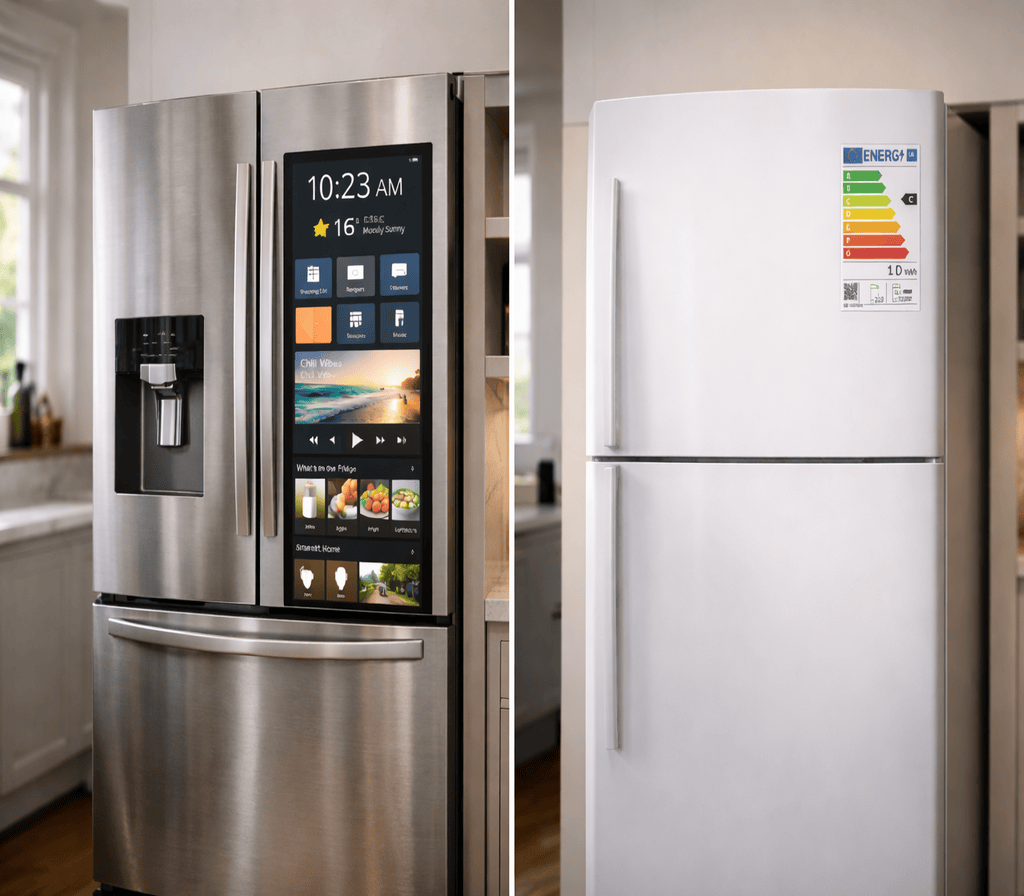
If you are considering upgrading your fridge this year, pause for a moment.
That sleek smart fridge with the touchscreen display and internal cameras may look impressive — but will it quietly increase your electricity bill?
With UK energy prices still higher than pre-2021 levels, choosing the wrong fridge could cost you hundreds of pounds over the next decade.
So before you spend £1,500 or more on a smart model, let’s examine what really matters: actual running costs, real UK electricity prices, and long-term value in 2026.
This guide breaks it down clearly — no hype, no guesswork.
Why This Decision Matters More in 2026
Electricity remains one of the most significant household expenses in Britain. Even under the Ofgem price cap, average electricity costs hover around 28p per kWh.
Refrigerators never switch off. They operate 24 hours a day, 365 days a year.
That means small differences in efficiency become large differences over time.
A fridge is not just a kitchen appliance — it is a permanent energy commitment.
What Exactly Is a Smart Fridge?
A smart fridge is essentially a connected refrigerator equipped with:
- Wi-Fi connectivity
- Touchscreen control panels
- Internal cameras
- Energy monitoring apps
- Voice assistant integration
- Smart temperature sensors
Premium models can:
- Track expiry dates
- Suggest recipes
- Send alerts if the door is left open
- Display your calendar or shopping list
Impressive? Certainly.
But every extra feature requires power.
What Counts as a Traditional Fridge in 2026?
Modern traditional fridges are far from outdated. Most UK models now include:
- Frost-free technology
- Digital thermostats
- Eco modes
- A-rated or B-rated efficiency
- Inverter compressors
They may lack Wi-Fi, but they are often engineered for lower baseline consumption.
The Core Question: Which One Costs More to Run?
Let’s look at realistic UK usage figures.
🇬🇧 Traditional Fridge (Standard 60cm Model)
- Annual usage: 120–180 kWh
- Estimated yearly cost: £34–£50
🇬🇧 Smart Fridge (American-Style Model)
- Annual usage: 250–400 kWh
- Estimated yearly cost: £70–£112
That means you could pay double in electricity for a smart fridge.
And that’s before considering purchase price.
Why Smart Fridges Use More Electricity
It is not just the touchscreen.
Energy increases due to:
- Larger capacity (most smart models are wide American-style units)
- Always-on Wi-Fi modules
- Continuous display screens
- Internal cameras
- More complex cooling systems
Size is the biggest factor.
Bigger fridge = more cooling demand.
10-Year Cost Comparison (The Part Most Buyers Ignore)
Let’s assume:
- Electricity price: 28p per kWh
- Average lifespan: 10 years
Traditional Fridge:
£40 per year × 10 years = £400
Smart Fridge:
£90 per year × 10 years = £900
That’s roughly £500 extra in electricity alone.
Now add purchase cost:
- Traditional fridge: £600 average
- Smart fridge: £1,800 average
Total long-term difference?
Potentially £1,300+ more.
That is not a small margin.
But Are Smart Fridges More Efficient Per Litre?
Here’s where it gets interesting.
Some high-end smart fridges actually have excellent energy ratings.
Per litre of storage, they may perform competitively.
However, because they are physically larger, total energy usage still tends to be higher.
Efficiency rating ≠ lowest electricity bill.
When a Smart Fridge Might Actually Make Sense
Despite higher energy costs, there are cases where smart models can be justified:
- Large families needing high storage
- Homes already using full smart home ecosystems
- Households trying to reduce food waste
- High-income households prioritising convenience
Food waste reduction can offset grocery costs — which indirectly saves money.
But this depends heavily on behaviour.
Hidden Costs Most People Do Not Consider
1. Repair Complexity
Smart components mean more expensive repairs.
2. Software Dependency
Some features rely on continued app support.
3. Screen Standby Consumption
Displays draw small amounts of power continuously.
4. Resale Value
Smart appliances depreciate faster due to tech cycles.
Environmental Considerations in the UK
Smaller traditional fridges typically:
- Require fewer manufacturing materials
- Produce lower transport emissions
- Consume less lifetime energy
Smart fridges may have better insulation technology — but overall footprint is usually larger.
If sustainability is your primary concern, compact high-rated traditional models often win.
Real UK Household Example
Let’s imagine a household in Birmingham:
Family of four
Standard electricity tariff
Mid-range fridge
Over 10 years:
- Traditional fridge: approx. £1,000 total (purchase + energy)
- Smart fridge: approx. £2,300 total
That difference could pay for:
- A holiday
- New flooring
- A new washing machine
Opportunity cost matters.
So Which One Should You Choose?
Choose a Traditional Fridge If:
- You want lower long-term costs
- Your kitchen space is limited
- Energy efficiency is your top priority
- You prefer simplicity
Choose a Smart Fridge If:
- You love integrated technology
- Budget is not a concern
- You value automation and connectivity
- You need very large storage
The Honest 2026 Verdict
For most UK households, traditional fridges remain the financially smarter option when focusing purely on electricity costs.
Smart fridges offer lifestyle upgrades — not energy savings.
They are about convenience, not bill reduction.
If your goal is to cut energy spending in 2026, investing in an A-rated traditional fridge delivers better value.
Final Thought Before You Upgrade
Ask yourself:
Are you buying a fridge to save money…Or to enjoy technology?
Both are valid reasons.
Just make sure you know which one you are choosing.
FAQ (Optimised for Snippet Potential)
Do smart fridges increase electricity bills in the UK?
Generally yes, especially larger American-style models.
Are smart fridges worth it financially?
Only if the convenience justifies the additional cost.
What fridge rating should I buy in the UK?
Aim for A or B under the new UK energy labelling system.