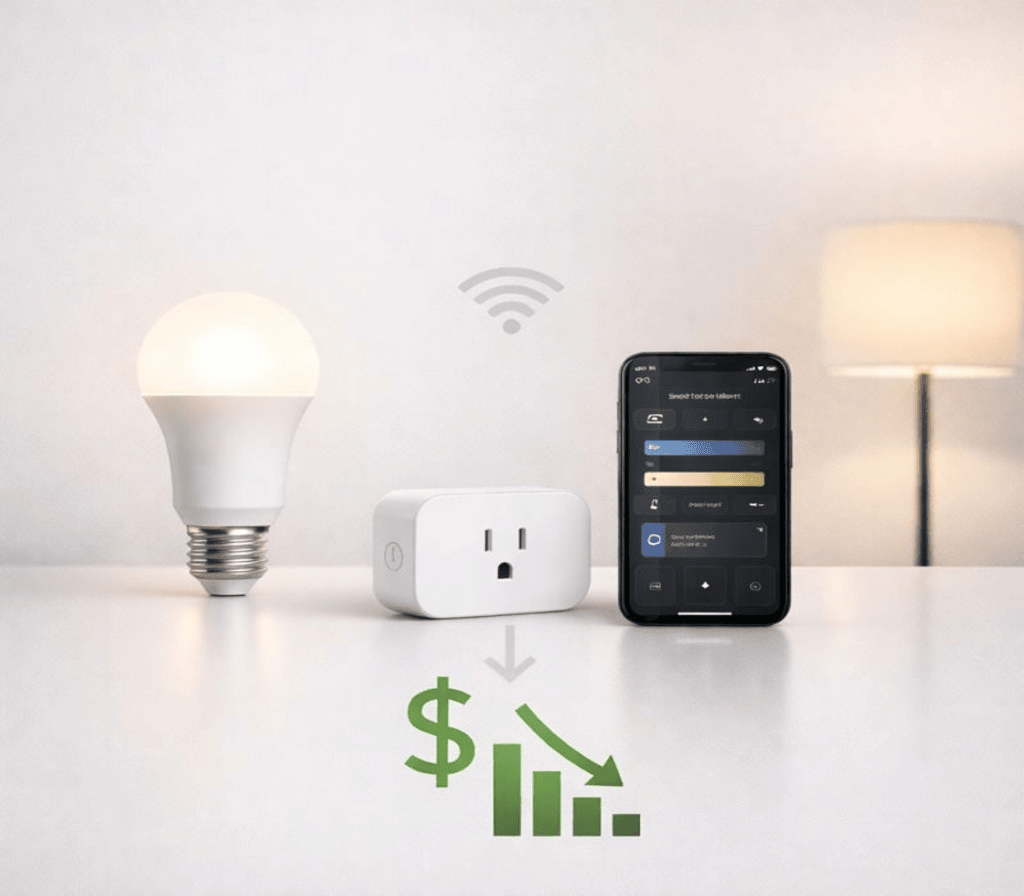
In an era of rising energy costs and increasing environmental awareness, homeowners are constantly seeking ways to reduce their household expenses and carbon footprint. While many focus on major appliances, one of the most overlooked areas for significant savings is often hanging right over our heads: lighting.
Traditional lighting systems are inefficient energy hogs, but the latest advancements in smart lighting offer a powerful solution. This article explores how smart lighting solutions can dramatically lower your electricity bills, detailing the technology, practical applications, and the real financial impact of making the switch.
1. The Core Technology: LED Efficiency & Smart Control
The foundation of smart lighting’s cost-saving power lies in two key innovations: LED technology and intelligent control systems.
LED: The Energy-Saving MVP
- Massive Efficiency Gains: Unlike incandescent bulbs that waste 90% of their energy as heat, LEDs are incredibly efficient, converting over 80% of electricity into light. A single 10-watt LED bulb can produce the same amount of light as a 60-watt incandescent, instantly cutting consumption by 83%.
- Exceptional Lifespan: LEDs last significantly longer—typically 25,000 to 50,000 hours, compared to 1,000-2,000 hours for incandescents. This reduces replacement costs and the environmental impact of manufacturing new bulbs.
Smart Control: Beyond the Switch
Simply having LEDs isn’t enough; smart control unlocks their full potential for savings.
- Dimming: Reducing a light’s brightness by just 20% can save a disproportionate amount of energy. Smart dimmers allow granular control via app or voice.
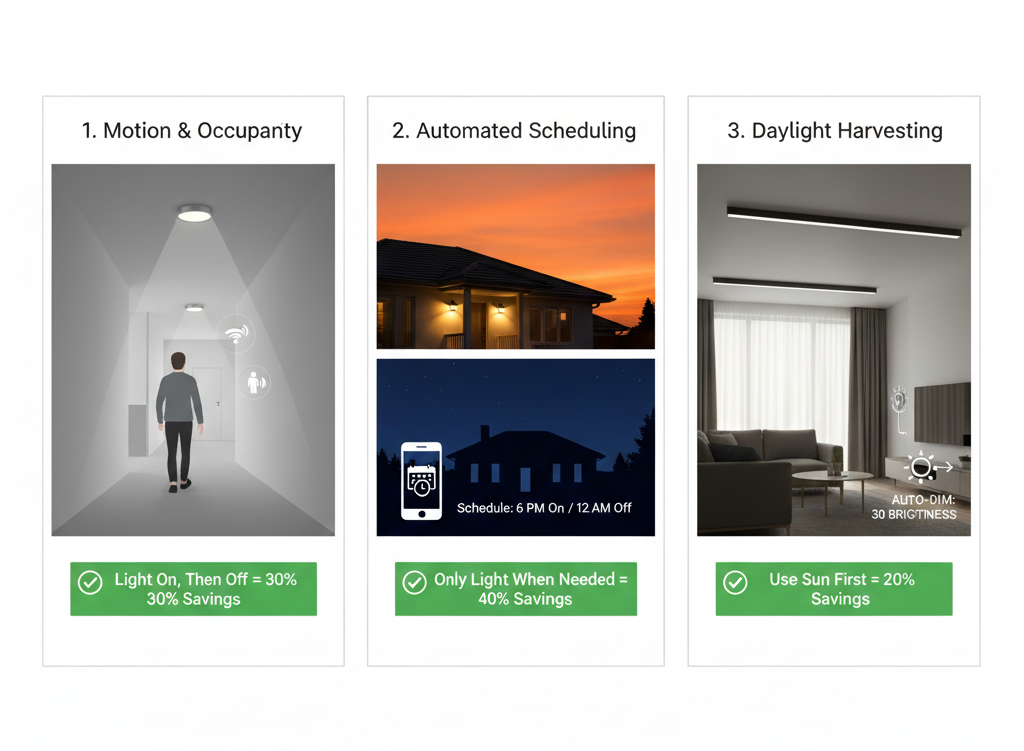
- Scheduling: Automate lights to turn on only when needed and off when not.
- Motion & Occupancy Sensors: Lights turn on automatically when a room is entered and off when it’s empty.
- Daylight Harvesting: Sensors detect natural light levels and automatically dim artificial lights, using sunlight as much as possible.
2. Practical Applications for Maximum Savings
a) Zoned Lighting: Heat Your Home, Don’t Light the Street
One of the biggest wastes in traditional lighting is illuminating unoccupied spaces. Smart lighting allows for zoning.
- How it saves: Instead of a single switch controlling all lights in an open-plan living area, you can create zones (e.g., “kitchen island,” “dining table,” “reading nook”). You only light the area you’re actively using.
- Example: When cooking, only the kitchen island lights might be at 80% brightness, while the rest of the living area is dimmed to 20%, saving significant energy compared to a “all or nothing” approach.
b) Automated Scheduling: Lights On When Needed, Off When Not
How many times have you left the house with lights on? Smart scheduling eliminates this human error.
- How it saves: Program lights to turn on at sunset and off at bedtime. Automate exterior lights to turn off at sunrise. Set bathroom lights to turn on only for 15 minutes in the morning.
- Example: A typical household with traditional exterior floodlights left on overnight for security might spend $50-$100 annually just on those lights. Smart scheduling can cut this to a fraction by ensuring they only activate when truly dark and then dimming or turning off after a set time.
c) Motion & Occupancy Sensors: The “Light-Sniffer”
Ideal for utility rooms, hallways, bathrooms, and walk-in closets, these sensors ensure lights are never left on by accident.
- How it saves: Lights turn on automatically upon entry and turn off after a set period of no motion. No more fumbling for switches or forgetting to turn them off.
- Example: A bathroom light, often left on for hours unnecessarily, could be programmed to turn off 5 minutes after detecting no motion, leading to substantial energy savings over a year.
d) Daylight Harvesting & Adaptive Brightness
This advanced feature uses ambient light sensors to dynamically adjust indoor lighting.
- How it saves: If a room has ample natural light streaming in, the smart lights will automatically dim to a lower intensity, supplementing the daylight rather than overpowering it.
- Example: On a bright, sunny afternoon, your smart living room lights might operate at only 30% brightness, gradually increasing as dusk approaches, ensuring perfect illumination without wasting energy.
3. Real-World Financial Impact: What Are the Savings?
The actual savings vary based on your home size, current lighting usage, and electricity rates. However, studies consistently show significant reductions.
- Average Household Savings: Switching from traditional to smart LED lighting can reduce lighting-related electricity consumption by 70% to 90%.
- Monetary Savings: For an average U.S. household spending $100-$200 annually on lighting, this translates to $70-$180 in annual savings. Over the 25,000-hour lifespan of an LED bulb (often 20+ years of typical use), the savings are substantial.
- ROI (Return on Investment): While smart bulbs are more expensive upfront ($15-$50 per bulb vs. $1-$5 for incandescents), the energy savings and reduced replacement costs mean they often pay for themselves within 2-3 years.
Beyond Electricity Bills: Additional Benefits
- Increased Property Value: Smart home features are increasingly attractive to potential buyers.
- Enhanced Security: Program lights to turn on and off randomly while you’re away, creating a “lived-in” look.
- Personalized Ambiance: Adjust color temperature and brightness to suit mood or task, enhancing comfort and productivity.
4. Getting Started: Smart Lighting Solutions
- Smart Bulbs: Easiest entry point. Simply replace existing bulbs with smart versions (e.g., Philips Hue, Sengled, LIFX). Connect via Bluetooth or a central hub.
- Smart Switches/Dimmers: For controlling entire circuits of non-smart LED bulbs. Great for overhead lighting. Brands like Lutron Caséta or Meross.
- Smart Light Strips: Flexible LED strips (often self-adhesive) for accent lighting, under cabinets, or behind TVs.
- Central Hub vs. Hub-less: Decide if you want a dedicated hub (more reliable for larger setups) or hub-less bulbs (simpler for small spaces, often Bluetooth-based).
Conclusion: Illuminate Smarter, Spend Less
Smart lighting is more than just a tech trend; it’s a strategic investment in energy efficiency and cost reduction. By harnessing the power of LEDs, automated control, and intelligent sensing, homeowners can dramatically lower their electricity bills while enjoying enhanced convenience, comfort, and security. The initial investment in smart lighting quickly pays for itself, making it one of the most practical and impactful smart home upgrades you can make today.